
A contractor downloads the bid package, flips to the insurance requirements, and hits the same wall that stops a lot of good jobs cold. The scope looks fine. The schedule is tight but manageable. Then the contract asks for higher liability limits, additional insured status, and proof of coverage that the current policy may not support.
That moment matters more than most owners think. General liability coverage limits aren't paperwork. They decide whether a business can sign the contract, survive a major claim, and keep working after a bad year. For a roofer, one falling debris claim can turn into bodily injury and property damage at the same time. For an HVAC contractor, a completed installation can trigger a claim long after the crew leaves the site. The wrong limits leave the business paying the gap.
Table of Contents
- Why Your Old Liability Limits May Not Be Enough
- Decoding Your Policy The Key Coverage Limits
- Typical General Liability Limits by Trade and Project Size
- How Job Contracts and COIs Determine Your Limits
- Bridging the Gap When to Add Umbrella Coverage
- A Contractor's Checklist for Choosing the Right Limits
Why Your Old Liability Limits May Not Be Enough
A lot of contractors still carry the limits that used to get them through smaller jobs and simple renewals. That old baseline was often enough to check a box. It isn't enough for many contractors anymore.

The hard truth is that the standard policy many owners still think of as “normal” now leaves a lot of businesses exposed. According to 2025 general liability insurance statistics, 22% of all general liability claims now exceed the standard $1 million per occurrence limit. The same source says 73% of companies operate while underinsured, which means the once-standard $1M/$2M policy is now a bare minimum, not a best practice.
That matters on real jobs, not just in theory. A masonry contractor can crack a neighboring wall during excavation support work. A landscaping company can damage irrigation, hardscape, and a nearby vehicle in one incident. A painter can trigger a fire loss in a leased shop or storage space. None of those losses ask what the owner hoped the policy would cover.
The financial gap lands on the business
When coverage runs out, the carrier doesn't keep paying because the claim is painful. The business absorbs the rest. That can mean writing checks, hiring defense counsel, delaying payroll, borrowing against equipment, or walking away from growth plans.
Practical rule: A coverage limit isn't a formality. It's the line between an insured loss and a business asset sale.
A contractor bidding larger jobs should read the insurance schedule in the contract before looking at price. If the owner or GC requires higher limits than the current policy carries, that's not legal fluff. It's a warning that the project exposure is bigger than the old policy was built for.
Claims tied to jobsite injuries and third-party lawsuits can get expensive fast. Contractors that want a clearer view of that exposure should review how client lawsuits and litigation affect general liability claims. The point isn't fear. The point is survival.
Old limits fit old operations
A small residential handyman doing minor repair work has a very different exposure than a framing contractor running multiple crews on active commercial sites. Yet many firms renew the same limits year after year without checking whether the work has changed.
That's where owners get trapped. Revenue goes up. Project size goes up. Contract requirements get stricter. The policy stays the same.
Decoding Your Policy The Key Coverage Limits
Most declarations pages look simple until a claim hits. Then the numbers start to matter. The easiest way to understand general liability coverage limits is to think of them as separate buckets of money with different rules.
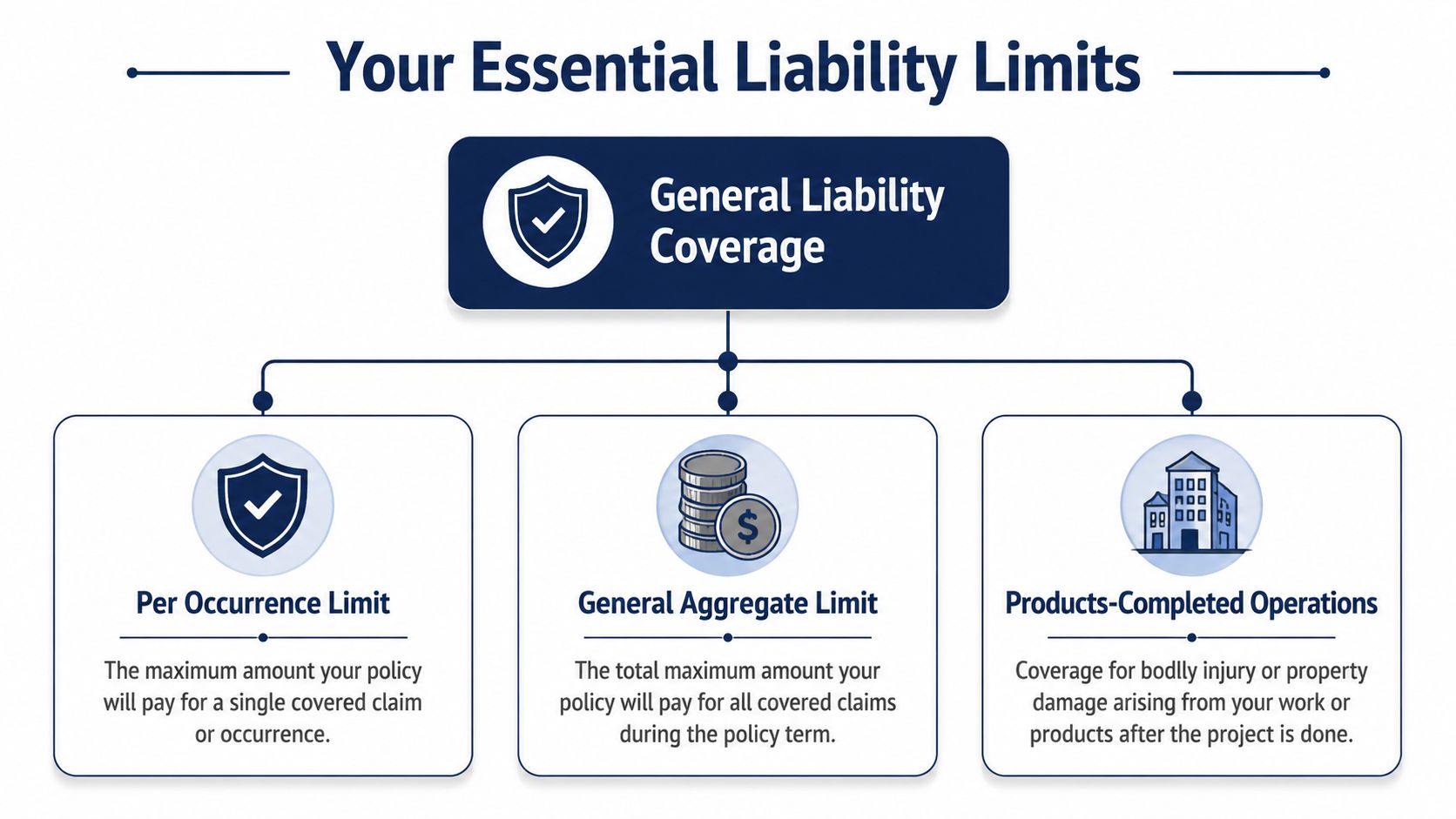
A standard policy isn't just one big pool. As explained in this breakdown of general liability insurance coverage limits, a standard Commercial General Liability policy has at least six distinct limits. The key ones for contractors are the Each Occurrence Limit, the General Aggregate, and the Products/Completed Operations Aggregate. A standard setup often shows $1M each occurrence, $2M general aggregate, and $2M products/completed operations aggregate.
For contractors that need the plain-English version of the form itself, this overview of general liability coverage basics helps connect the policy wording to jobsite risk.
The per occurrence limit
This is the cap for one claim event. If one incident injures a third party or damages property, this limit is the first ceiling.
Take an electrician working in an occupied office renovation. A mistake sparks a fire that damages a tenant suite and causes smoke damage beyond the immediate work area. That's one occurrence. The policy responds up to the each occurrence limit, subject to the actual policy terms.
This is the number owners usually quote because it's easy to remember. It's also the number that gets too much attention by itself.
The general aggregate
This is the total bucket for covered non-products claims during the policy term. It matters for contractors with repeated exposure across many jobs, crews, and locations.
A plumbing contractor might have one slip-and-fall claim from a jobsite visitor, one property damage claim from a burst line during work, and another third-party injury claim later in the year. Each claim may fit under the per occurrence limit, but together they chew through the aggregate.
Contractors don't go broke only from one huge loss. They also get squeezed by several medium-sized losses in one policy year.
That's why aggregate limits deserve more attention than they usually get. An owner who only asks, “What's the per occurrence?” is reading half the page.
The completed operations bucket
This is the separate pool for claims that show up after the work is finished. That separation matters. A completed job can fail months later, and that claim can come out of the products/completed operations aggregate instead of the general aggregate.
For an HVAC contractor, this is a major issue. A bad installation might not cause a problem on startup day. The claim can arrive later when condensation damages interiors, equipment malfunctions, or the finished system causes property damage after turnover.
Here's the good news. The completed operations bucket is separate from the general aggregate under the standard structure described above. A later post-job claim doesn't automatically drain the money reserved for active operations claims.
That separation gives contractors room to survive both current jobsite problems and post-completion allegations. But it only helps if the limits themselves are large enough for the work being done.
Typical General Liability Limits by Trade and Project Size
A contractor asking, “What limits should the business carry?” deserves a direct answer. Start with the trade, then adjust for project size, crew count, and subcontractor exposure.
A solo residential service plumber has different risk than a restoration firm managing water losses with multiple subcontractors moving in and out of occupied buildings. A small drywall contractor working tenant improvements has a different exposure than a general contractor coordinating structural, electrical, and mechanical trades on one site.
A practical benchmark table
The table below gives a starting point, not a final answer.
| Trade | Typical Per Occurrence Limit | Typical Aggregate Limit |
|---|---|---|
| Electricians | $1M | $2M |
| Plumbers | $1M | $2M |
| HVAC contractors | $1M | $2M |
| Landscapers | $1M | $2M |
| Roofers | $2M | $4M |
| Concrete contractors | $2M | $4M |
| General contractors | $2M | $4M |
| Restoration firms | $2M | $4M |
Those higher starting points for some trades aren't arbitrary. They reflect heavier third-party exposure, defect allegations, and the fact that one bad incident can involve several damaged parties at once.
When the table stops being enough
Subcontractor use changes the math fast. For contractors where subs perform a large share of the work, this analysis of contractor subcontractor coverage limitations notes that general contractors and restoration firms often have subs performing 60-80% of the work, standard GL policies may contain limitations or lower sub-limits such as $500K vs $1M if proper COIs aren't secured, and 40% of litigated claims involve subcontractors. It also points high-risk contractors toward base limits such as $2M per occurrence and $4M aggregate.
A GC who subs out most framing, roofing, and mechanical work isn't transferring all the risk just because someone else swung the hammer. If a sub causes damage and the paperwork is weak, the claim can come back through the GC's program.
Contractors dealing with that exposure should review general liability options for general contractors before bidding larger jobs or stacking multiple active sites.
Consider these pressure points:
- Larger contract values: Bigger jobs attract bigger claims and stricter insurance requirements.
- Occupied buildings: Work in schools, apartments, offices, and medical settings raises the cost of a mistake.
- Multiple crews at once: More sites mean more chances for losses in the same policy term.
- Heavy subcontractor use: Poor COI tracking can leave the prime contractor holding the bag.
A trade business usually outgrows its limits before it realizes it has.
How Job Contracts and COIs Determine Your Limits
A lot of contractors believe they choose their limits. On smaller work, that's partly true. On larger jobs, the contract often chooses for them.
A general contractor reviews a project owner's insurance exhibit and sees a familiar list. Specific liability limits. Additional insured status. Primary and noncontributory wording. Completed operations requirements. None of that is filler. It's the owner shifting risk downstream to the parties doing the work.

What the contract is really asking for
When a contract requires a contractor to name the owner or GC as an additional insured, it usually means they want access to the contractor's liability policy for claims tied to that contractor's work. They don't want their own insurance responding first if the claim belongs downstream.
For a steel subcontractor, that can matter on day one. If a delivery damages site property or a welding operation causes third-party loss, the upstream party wants the sub's policy lined up to respond according to contract.
That also means the contractor's policy has to support the request. Not every policy form, endorsement package, or limitation handles subcontractor and additional insured obligations the same way. Contractors dealing with shared-site exposure should understand how subcontractor liability affects general liability coverage.
Why COIs become a jobsite gatekeeper
The certificate of insurance is usually the document everyone asks for first, but it's only useful if it matches the contract and the underlying endorsements. A certificate that shows the wrong named insured, expired dates, or missing additional insured language can stop mobilization.
For a restoration contractor responding to a commercial water loss, that delay can cost the job. The owner wants confirmation before equipment enters the building. The GC wants documentation before the sub touches the site. The lender or property manager may want their own wording reviewed too.
A smart contractor checks these items before the start date:
- Named insured accuracy: The legal business name must match the contract.
- Policy dates: Coverage needs to remain active through the job timeline.
- Required endorsements: Additional insured and related wording should match the contract requirement.
- Limit adequacy: The certificate should reflect the limits the project demands.
The COI doesn't create coverage by itself. It only reflects what the policy and endorsements actually provide.
That's why owners shouldn't treat certificates like decoration. They're access documents. If the COI package is wrong, the crew may not get on site.
Bridging the Gap When to Add Umbrella Coverage
Umbrella coverage stops being optional when the primary limits no longer match the size of the risk. That usually happens before the owner is comfortable admitting it.
A contractor can have solid general liability limits and still run out of room. The problem isn't always one catastrophic verdict. Sometimes it's a bad year with several claims, legal expense, and multiple projects staying active while the policy burns down.
How limits get burned faster than expected
This summary of general liability limit erosion and aggregate exhaustion makes the issue plain: a $2M General Aggregate can be depleted quickly, and after two separate $800K claims in one year only $400K remains for other incidents. The same source says small businesses exhaust their aggregates in 15% of multi-claim years, and it notes that defense costs can also erode limits depending on policy wording.
That's why umbrella coverage matters. It adds another layer above the underlying policy. If the primary general liability policy pays up to its limit on a covered loss, the umbrella can step in above that amount, subject to its terms.
For a concrete contractor, this is easy to understand with a field example. One claim comes from a site visitor injury around an open work area. Another comes later from property damage tied to the same season's jobs. The primary policy starts paying both. The aggregate drops. Then a third serious claim hits before renewal. That's the point where a business learns whether it bought enough headroom.
Contractors looking at larger accounts can review umbrella and excess liability options as part of a full liability program, not as an afterthought.
Who should stop treating umbrella as optional
Some contractors need umbrella coverage more urgently than others. The pattern is predictable.
- Multi-crew operators: More people and more sites create more claim opportunities in one policy term.
- Firms bidding commercial or public work: Contract requirements often push total liability towers higher than basic GL limits.
- Trades with severe injury potential: Roofing, concrete, demolition, and structural work can produce large third-party claims.
- Businesses with assets worth protecting: Once the company has equipment, receivables, and cash flow to defend, thin limits become dangerous.
A contractor doesn't buy umbrella because it sounds advanced. The business buys it because primary limits are finite and claims don't care what the owner budgeted.
One practical note belongs here. Coverage Axis is an independent advisor that shops multiple carriers for contractor liability programs, including umbrella layers, which matters when a business needs higher limits that still fit the trade and project mix.
A Contractor's Checklist for Choosing the Right Limits
General liability coverage limits should be chosen the same way a contractor sizes a beam or bids a schedule. Use the actual load, not a guess.
The decision process
A contractor can make this decision cleanly by working through the business in order:
- Start with the trade exposure. A residential service contractor may start lower than a GC, roofer, or restoration firm running multiple active jobs.
- Read the top contracts. The largest clients usually tell the business what the market expects. If contract requirements already exceed the current policy, the policy is behind the operation.
- Measure simultaneous job exposure. One crew on one site is one thing. Several crews across several sites can create multiple claims in the same term.
- Review completed work risk. Trades like HVAC, plumbing, roofing, and electrical work can trigger post-job allegations after turnover.
- Audit subcontractor dependence. If subs do a large share of the work, the contractor should assume paperwork failures will eventually happen and plan limits accordingly.
- Check whether umbrella is now part of the baseline. Once jobs, assets, and contractual demands expand, excess liability usually belongs in the program.
The mistake to avoid at renewal
The most common mistake is simple. Owners renew based on last year's premium and last year's declarations page, not on this year's jobs.
That approach works until it doesn't. A flooring contractor moves from small residential work into occupied commercial tenant improvements. An outdoor services provider starts handling larger site packages. A plumbing company adds crews and signs bigger service agreements. The business changes first. The policy often lags behind.
Review limits before a major bid, before signing a new master service agreement, and before renewal. Waiting for a claim is the expensive version of planning.
The right limit is the one that matches the business the contractor is running today.
Coverage Axis helps contractors review general liability coverage limits, subcontractor exposure, contract requirements, and umbrella needs in plain English. A licensed advisor can shop the market, compare options across carriers, and build a right-sized program for the trade, crew size, and project mix. Request a free coverage review or quote from Coverage Axis before the next renewal or bid package puts the business in a corner.