A lot of roofing contractors are staring at the same problem right now. A job is ready to start, the contract is in hand, and the insurance section reads like a legal puzzle. It asks for $1 million per occurrence, $2 million aggregate, additional insured status, maybe completed operations, maybe waivers, and nobody wants to mobilize a crew until the paperwork is right.
That's where many roofing businesses get exposed. They buy a general liability policy because the client asked for one, but they never check whether the policy matches the work they perform. For roofers, that gap matters more than it does in many other trades. A policy can look acceptable on the certificate and still fail when a real claim hits.
General liability insurance for roofers isn't just a licensing box or contract attachment. It's a business tool that keeps one accident, one leak allegation, or one bad endorsement from turning into a cash crisis.
Table of Contents
- What General Liability Actually Covers on a Roofing Job
- The Fine Print That Can Sink a Roofing Business
- Decoding Contracts Additional Insureds and COIs
- What Drives Your Roofing Insurance Cost
- Real Roofing Claims and How Coverage Responded
- How to Get the Right Roofer Liability Policy
What General Liability Actually Covers on a Roofing Job
A crew tears off a section at 9 a.m. By noon, debris has cracked a neighbor's windshield, and before the day is over the homeowner says a delivery driver twisted an ankle walking through the work area. That is the kind of day general liability is built for.
General liability insurance responds when your roofing operations allegedly cause bodily injury or property damage to someone else. In plain terms, it is the policy that steps in when a third party says your job caused the loss. If you want a broader baseline before getting into roofing-specific issues, this guide to general liability insurance for contractors lays out the standard framework.
On a roofing job, that usually means claims such as falling tools, drifting debris, damaged siding, broken windows, or injuries to visitors, delivery drivers, tenants, and pedestrians. Roof work creates a lot of exposure outside the roofline. The loss does not have to happen on the shingles to become your problem.
Here is the line roofers need clear from the start. General liability is built for third-party claims. It does not pay for employee injuries, damage to your own truck, stolen equipment, or the cost to redo your own faulty work.
The core jobsite protection
The easiest examples are active jobsite losses.
A bundle slides and dents a customer's vehicle. Tear-off debris punches through a patio cover. A magnet sweep misses nails and a visitor gets injured. Those are the claims most contractors expect a liability policy to handle, and in many cases they are right.
Defense costs matter too. Even when the allegation is exaggerated or flat wrong, the policy can provide a legal defense for covered claims. For a roofer, that alone has real value. One disputed injury claim can burn through cash fast, even before anyone talks settlement.
The terms that matter in plain English
Three terms drive most roofing liability discussions.
| Term | What it means on a roofing job |
|---|---|
| Occurrence | One claim event, such as a single accident causing injury or property damage |
| Aggregate limit | The most the policy pays across covered claims during the policy term |
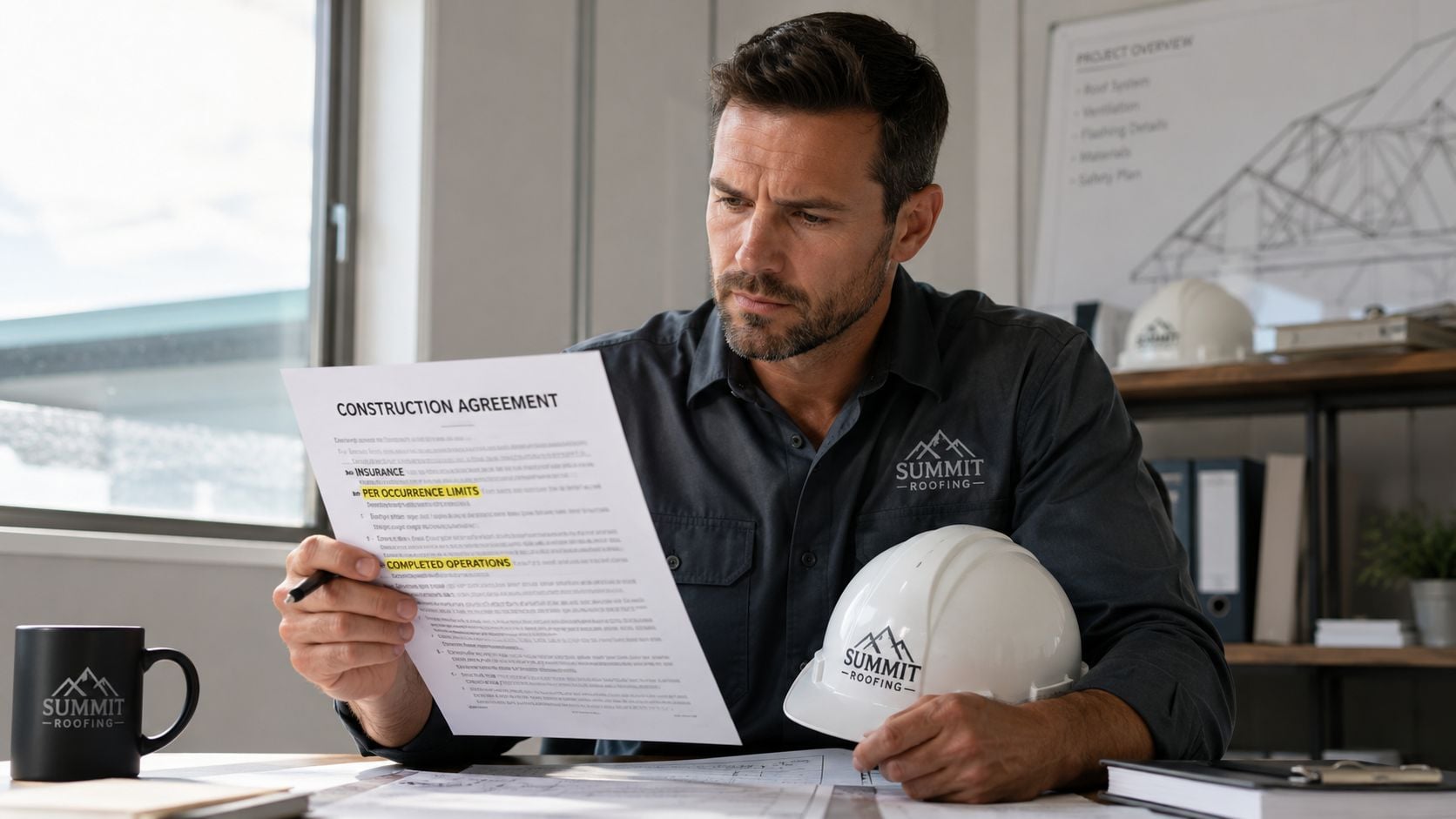
| Completed operations | Protection tied to claims that show up after the work is finished |
An occurrence limit matters because one bad drop, one fire, or one serious injury can turn into a six-figure claim. The aggregate matters because roofing losses tend to come in clusters. A contractor can have two modest property damage claims and then get hit with a larger water claim later in the same policy year.
Completed operations deserves special attention in roofing. A roof can pass final walkthrough, survive the first invoice, and still produce a leak claim weeks later. If water gets into insulation, drywall, flooring, or inventory after the crew has left, that claim usually falls into completed operations territory.
That is where many roofers get blindsided. They assume "roofing" on the declarations page means post-job leak claims are covered. Sometimes they are. Sometimes an endorsement narrows that protection, especially for water intrusion, certain roof systems, steep-slope work, or jobs above a stated height. The declarations page gives you the headline. The endorsements decide whether a late-reported leak becomes an insured claim or a business-threatening bill.
For roofers, general liability is less about meeting a contract requirement and more about protecting the balance sheet when a routine job turns into a third-party claim.
The Fine Print That Can Sink a Roofing Business
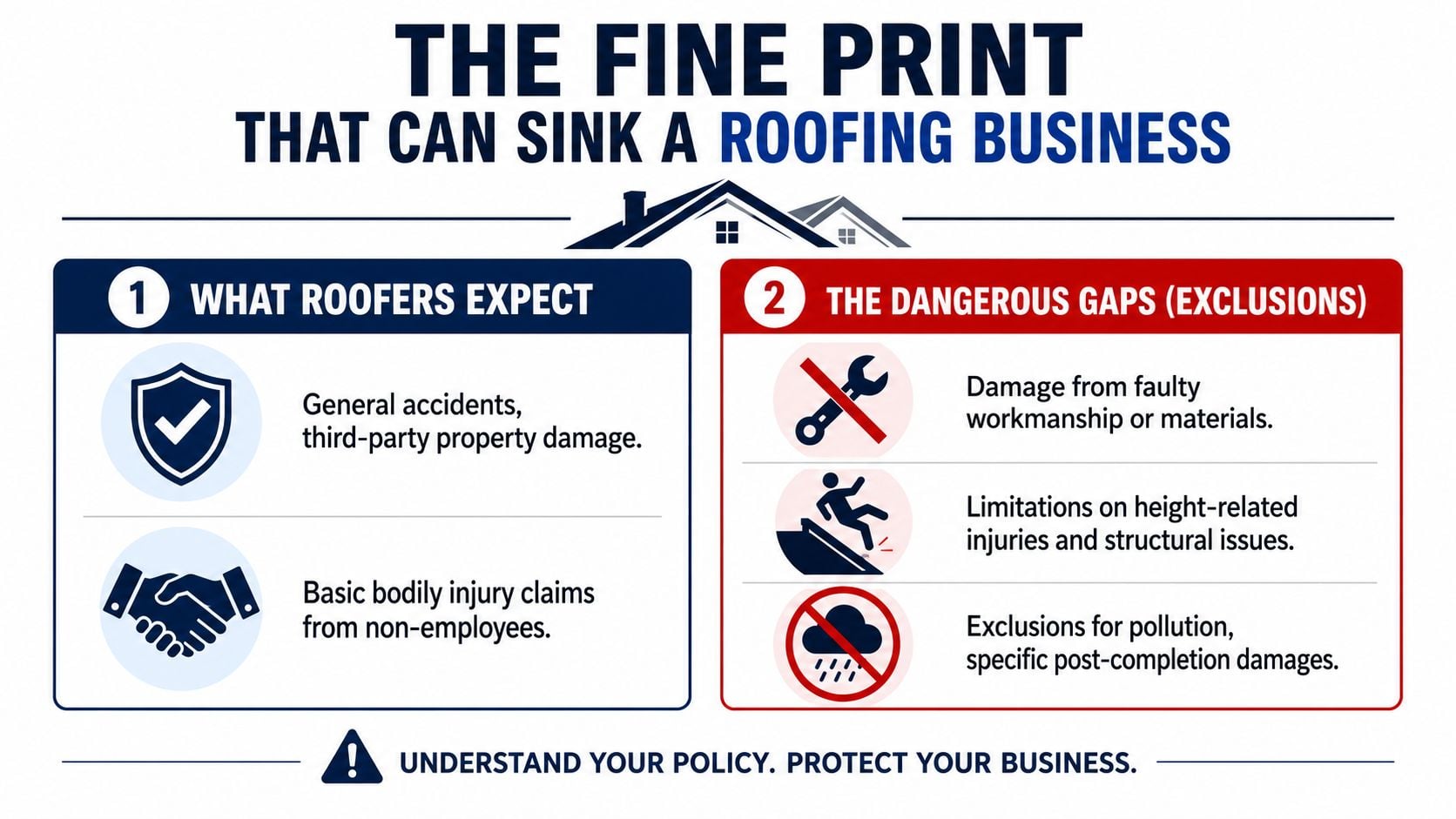
Many roofers assume a standard general liability policy is enough because the declarations page shows the right limits. That assumption causes a lot of denied claims. Roofing is a high-risk trade, and carriers often carve out the very exposures contractors thought they were buying coverage for.
The damage usually shows up when a claim adjuster reads the endorsements instead of the certificate. The certificate says the policy exists. The endorsements decide whether the claim gets paid.
A lot of roofing contract disputes also overlap with indemnity language, so contractors dealing with hold harmless clauses and transfer-of-risk language should understand what contractual liability means before signing broad project agreements.
Why a standard policy often fails roofers
Some exclusions are obvious. Most contractors understand that poor workmanship itself may not be insured just because a policy says “general liability.” The more dangerous exclusions are the quiet ones tied to the type of roofing work.
The problem shows up in jobs involving torch-down systems, taller structures, condo work, or residential forms with narrow completed-work language. A cheap policy can be valid on paper and still be almost useless in the field.
Research cited by this roofing liability exclusion analysis states that 68% of roofing GL denials stem from overlooked exclusions like hot tar operations, structures over three stories, and condominium work, and that emerging 2026 data shows carriers are requiring three-story waiver endorsements for commercial roofers, a requirement unmentioned in 90% of existing content.
The most expensive roofing policy is the cheap one that excludes the work the crew actually performs.
The exclusions that deserve a direct review
A roofer doesn't need to memorize policy form numbers. But every roofer does need to ask direct questions before binding coverage.
- Hot work exclusions: Torch-down, hot tar, or similar operations may be excluded unless specifically accepted.
- Height restrictions: Some policies limit or exclude work above a certain building height, which becomes a problem on multi-story commercial jobs.
- Condominium or residential restrictions: A carrier may accept one class of roofing work while excluding another.
- Post-completion damage limitations: Water intrusion, mold-related allegations, or damage discovered later may be narrowed by endorsement language.
- Subcontracted work limitations: If a business subs out labor, the policy may impose conditions around written agreements and proof of downstream coverage.
A practical trade example: a roofing contractor lands a mid-rise re-roof for a small apartment building. The certificate looks clean, but the policy excludes structures over three stories unless a waiver is added. During tear-off, debris damages a parked vehicle and the owner tenders the claim. The contractor learns too late that the building type sat outside the policy's accepted scope.
That's why the right question isn't “Do you have GL?” It's “Does the policy include this exact kind of roofing work without the exclusions that matter on this job?”
Decoding Contracts Additional Insureds and COIs
Most roofing insurance headaches don't start with a claim. They start when a general contractor, property manager, or owner says the job can't begin until the certificate is corrected.
This part of the process doesn't have to be complicated, but it does need to be handled cleanly. Contracts often ask for additional insured status, a certificate of insurance, and sometimes other policy wording that needs to match the agreement.
Roofers bidding public work or formal subcontract packages can reduce paperwork mistakes by using structured proposal workflows. For teams that need cleaner submission packets, government proposal software can help organize contract requirements before insurance requests start coming back for revisions.
What additional insured status really means
When a client asks to be an additional insured, they're asking for protection under the roofing contractor's liability policy for claims tied to the contractor's operations, subject to the policy and endorsement wording. It's standard in construction. It's not a red flag by itself.
The issue is that contractors often treat additional insured status like a box to check, when it's really a documentation exercise with legal consequences. The named entity has to be correct. The endorsement has to match the contract. The timing matters too.
Contractors that need a cleaner explanation of endorsement mechanics can review how an additional insured endorsement works before sending certificates out.
How to handle COI requests without slowing the job
A certificate of insurance, or COI, works like the business's insurance ID card. It shows the carrier, policy dates, limits, and the named insured. It can also reflect certificate holders and, in some cases, reference additional insured wording if the endorsement has been issued.
A practical trade example: a roofer is hired to replace a retail strip center roof. The property manager sends over a contract requiring the ownership entity, the management company, and the lender's asset arm to be listed correctly. If even one name is off, site access gets delayed.
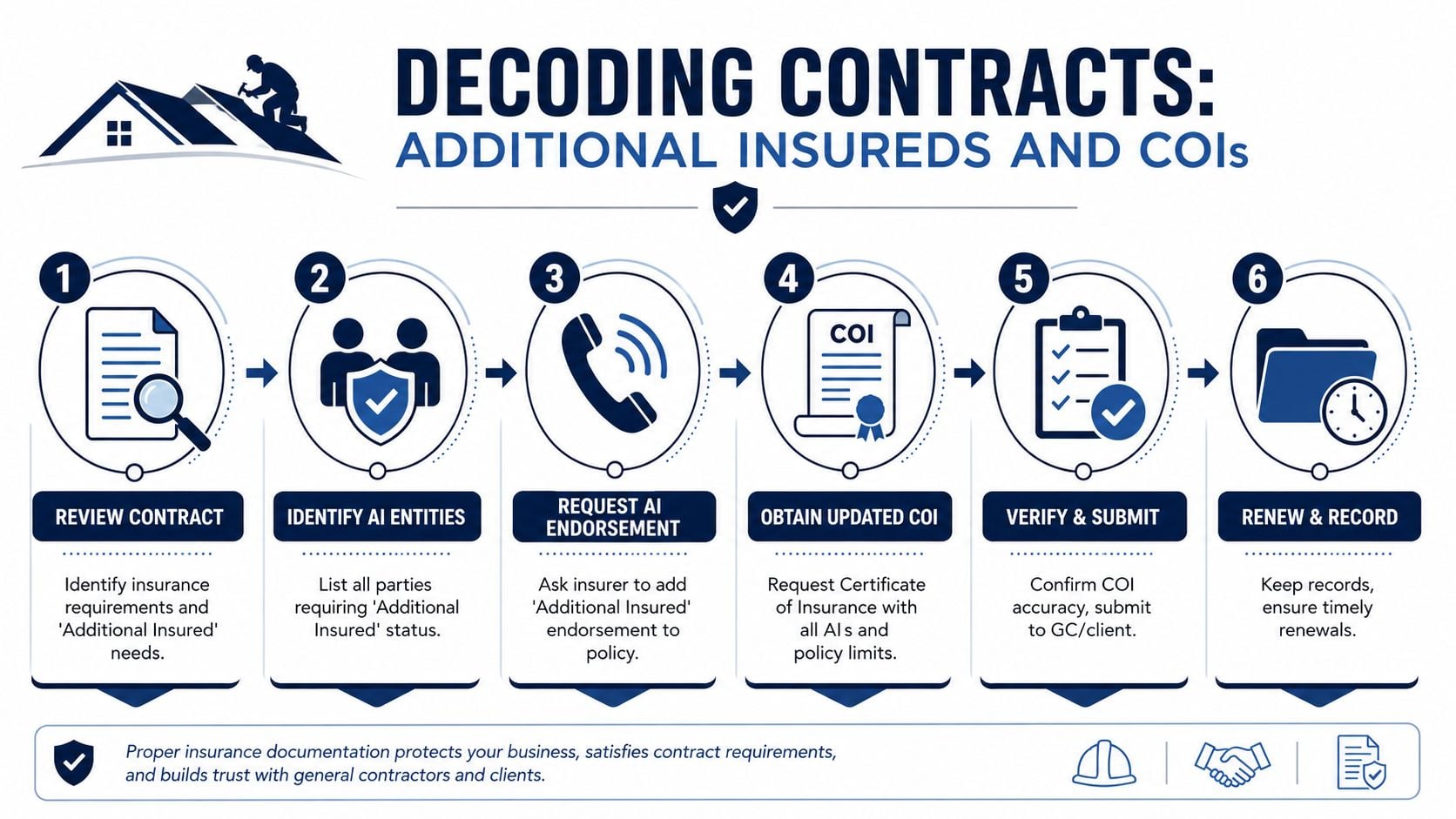
A simple process keeps this under control:
- Read the insurance exhibit early. Don't wait until crews are scheduled.
- List every entity exactly as shown in the contract. Small naming errors cause avoidable rejections.
- Ask whether additional insured status is blanket or scheduled. That affects what has to be issued.
- Request the updated COI before mobilization. Don't assume same-day turnaround from every carrier.
- Save the certificate, endorsement request, and contract page together. That file matters if a dispute comes later.
A clean COI process doesn't just satisfy paperwork. It shortens the time between signed contract and paid work.
What Drives Your Roofing Insurance Cost
A roofer gets two quotes for the same limit and assumes the lower one is the win. Then a contract lands, the carrier adds a height restriction, and a water-intrusion exclusion shows up in the endorsement schedule. The cheap quote just got expensive.
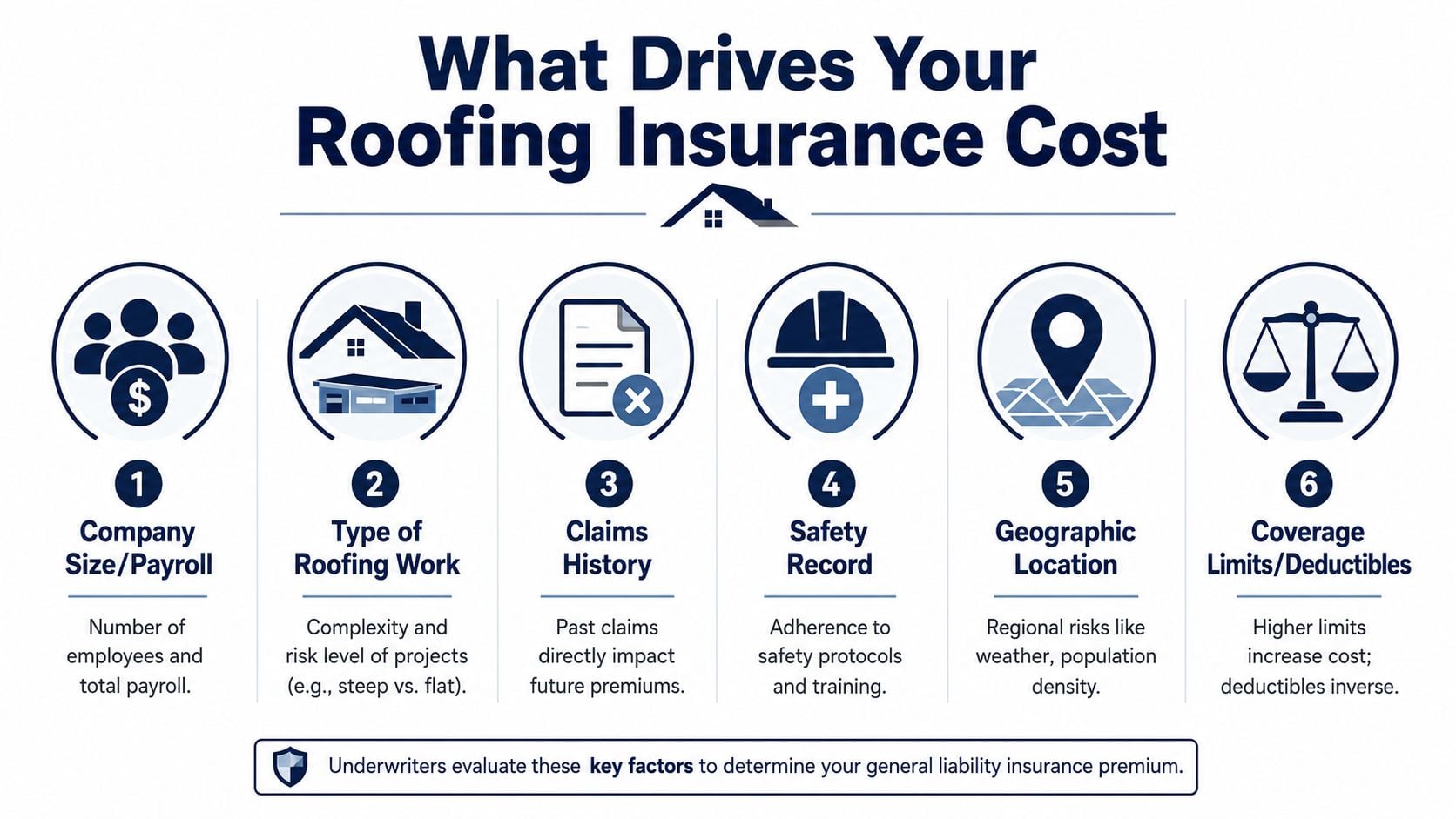
Price matters, but roofing liability pricing is tied to how the underwriter reads your operation. They are looking at what kind of roofs you touch, how often you open a building to weather, whether you run torch work, how many crews are active at once, and whether your policy form keeps or strips out the completed operations protection that matters when leaks show up after the job is done.
What roofers are paying
Roofing general liability is rarely priced like a simple commodity policy. Small owner-operator firms can land in one range. Larger crews, higher payroll, commercial reroofing, steep-slope work, and heat-applied systems push the number up fast. In practice, the premium gap between two roofers with similar revenue often comes down to classifications, loss history, and exclusions, not just company size.
Another point gets missed in a lot of quote comparisons. General liability may be only one line item, but workers' compensation and commercial auto often rise alongside growth, so the total insurance budget changes faster than many owners expect. For a broader frame on how carriers price by trade and exposure, this guide to general liability insurance cost for contractors is a useful reference.
What underwriters are really pricing
Underwriters do not price roofing risk from revenue alone. They price the chance that a claim will be severe, hard to defend, or excluded badly enough to create a dispute.
| Cost driver | Why it matters |
|---|---|
| Revenue and payroll | More jobs, more crew hours, and more subcontracted activity create more chances for third-party injury or property damage |
| Roof type and method | Steep-slope, commercial tear-offs, tile, metal, and heat-applied systems usually bring tougher underwriting |
| Height and job conditions | Some carriers restrict work above certain heights or on specific occupancies |
| Claims history | Prior leak claims, falls, or repeat water losses signal control problems and raise pricing |
| Coverage form and endorsements | Broader completed operations language costs more. Exclusions for water intrusion, subs, or residential work can lower premium while gutting protection |
The endorsement schedule changes the price more than many roofers realize. A policy with a residential limitation, a height exclusion, or a material-specific exclusion for torch-down or hot asphalt may come in cheaper because the carrier removed part of the exposure that causes the worst losses. That is not savings if your jobs fall inside the carve-out.
Completed operations is another big one. A carrier that is nervous about post-job leak claims may narrow or exclude parts of that exposure, especially where repeated water intrusion claims have hurt the roofing book. If your work includes reroofs on occupied buildings, churches, retail centers, condos, or any structure where one missed flashing detail can damage interiors days later, that wording deserves line-by-line review.
Territory matters too. Catastrophe-prone states, aggressive litigation venues, and dense urban service areas usually cost more because claim severity is higher. Fleet size and driving habits also affect the overall account, especially if supervisors, estimators, and crews are running trucks between multiple sites each day. Operations managers who want tighter route control and better vehicle oversight may get practical ideas from this article on how commercial vehicle tracking helps UK fleets.
Field advice: If one roofing quote is much lower than the others, read the exclusions first. I usually find the discount hiding in completed operations wording, water-intrusion language, subcontractor restrictions, or a height limitation that does not match the work.
Real Roofing Claims and How Coverage Responded
Policies feel abstract until a claim lands. Roofing claims are easier to understand when they're tied to actual job conditions, because the line between covered loss and denied loss usually comes down to what happened, when it happened, and what the endorsements said.
A tarp failure during a storm
A crew tears off part of a residential roof and drys in for the evening. Overnight weather shifts, the tarp lifts, and water gets into the attic and stains interior ceilings. The homeowner also claims damage to hardwood flooring below a ceiling leak.
If the loss ties to active operations and the policy is written correctly for roofing, this is the type of third-party property damage claim that often triggers a general liability response. But the details matter. The carrier will look at site protection, timing, weather, and whether any exclusion narrows the loss.
A practical trade example: the roofer did the right thing operationally by documenting the dry-in, taking photos before leaving, and reporting the event quickly. Good claim files don't guarantee payment, but weak documentation definitely hurts.
A falling material injury claim
On a commercial reroof, a bundle shifts near the edge and debris falls outside the controlled work zone. A pedestrian suffers an injury and alleges the contractor failed to secure the site properly.
This is the classic bodily injury side of a liability claim. The policy may defend the roofer and address covered damages, but the investigation will focus on barriers, warnings, housekeeping, and whether subcontracted labor was involved.
The lesson isn't just “have insurance.” It's pair insurance with disciplined jobsite practices. Liability coverage works best when the contractor can show what controls were in place before the incident.
Keep a claim file the same way a contractor keeps a job file. Photos, site logs, contract pages, and who was on site matter once attorneys get involved.
The leak that showed up after the crew left
This is the claim that catches roofers off guard. The project closes out, final payment comes in, and weeks or months later the property owner reports a leak. They blame flashing, penetration work, or a detail at a transition the owner says was part of the original job.
Verified trade data states that 34% of roofing liability claims involve post-completion water intrusion, and that standard GL policies can leave roofers exposed when those leaks appear later. The same source notes new 2025 underwriting trends require explicit 12-month completed operations clauses for roofers working on residential properties, according to this completed operations analysis for roofing companies.
That matters because a finished roof can still create a live liability problem after the crew packs up. One contractor may have the right completed operations wording and survive the claim process. Another may spend heavily on legal help and repairs because the policy language never properly addressed delayed water intrusion exposure.
How to Get the Right Roofer Liability Policy
Roofers get in trouble when they buy general liability the way they buy office supplies. Lowest price, quick bind, move on. That approach works fine until the first serious claim tests the exclusions.
The right policy starts with an honest description of the work. Residential or commercial. Steep-slope or flat. Tear-off or overlay. Heat-applied systems or not. Subcontractors or self-performed labor. Multi-story work or not. The cleaner that submission is, the better the quote review will be.
Contractors who want a broker-side explanation of market access and policy comparison can review what an independent insurance broker does differently from a one-carrier sales setup.
What to compare besides price
A roofing liability quote should be read in layers.
- Carrier strength: Check that the insurer is financially credible for construction claims.
- Class code fit: Make sure the policy is written for roofing operations, not a broader contractor class that hides restrictions.
- Endorsement schedule: Look for exclusions tied to heat work, height, residential jobs, condo work, or subcontracted labor.
- Completed operations wording: Read this carefully if the business does residential reroofs or any project where leak allegations may show up later.
- Contract compatibility: Confirm the policy can support the additional insured and COI requirements common in roofing contracts.
A buying checklist that fits roofing work
A practical trade example: a roofer compares two quotes for the same policy limits. One is cheaper. But once the endorsements are reviewed, it excludes torch work, narrows building height, and limits the very jobs that make up the contractor's backlog. That quote isn't cheaper. It's incomplete.
Use a short checklist before binding:
- Match the policy to the actual jobs on the schedule.
- Ask for all roofing-specific exclusions in writing.
- Review completed operations language before accepting the quote.
- Confirm the policy can satisfy contract insurance requirements.
- Make sure the business can get COIs and endorsements turned around quickly.
- Recheck the policy whenever the company adds crews, states, or project types.
General liability insurance for roofers works when it's built around the contractor's real operations. It fails when it's treated like generic paperwork. In roofing, the difference between those two approaches can decide whether one leak allegation becomes a normal claim or a business-threatening event.
Coverage Axis offers a free coverage review and quote for roofing contractors who want to check exclusions, completed operations wording, COI readiness, and the overall fit of their liability program before the next job starts.